
The Hidden Cost of Not Forecasting Enrollment
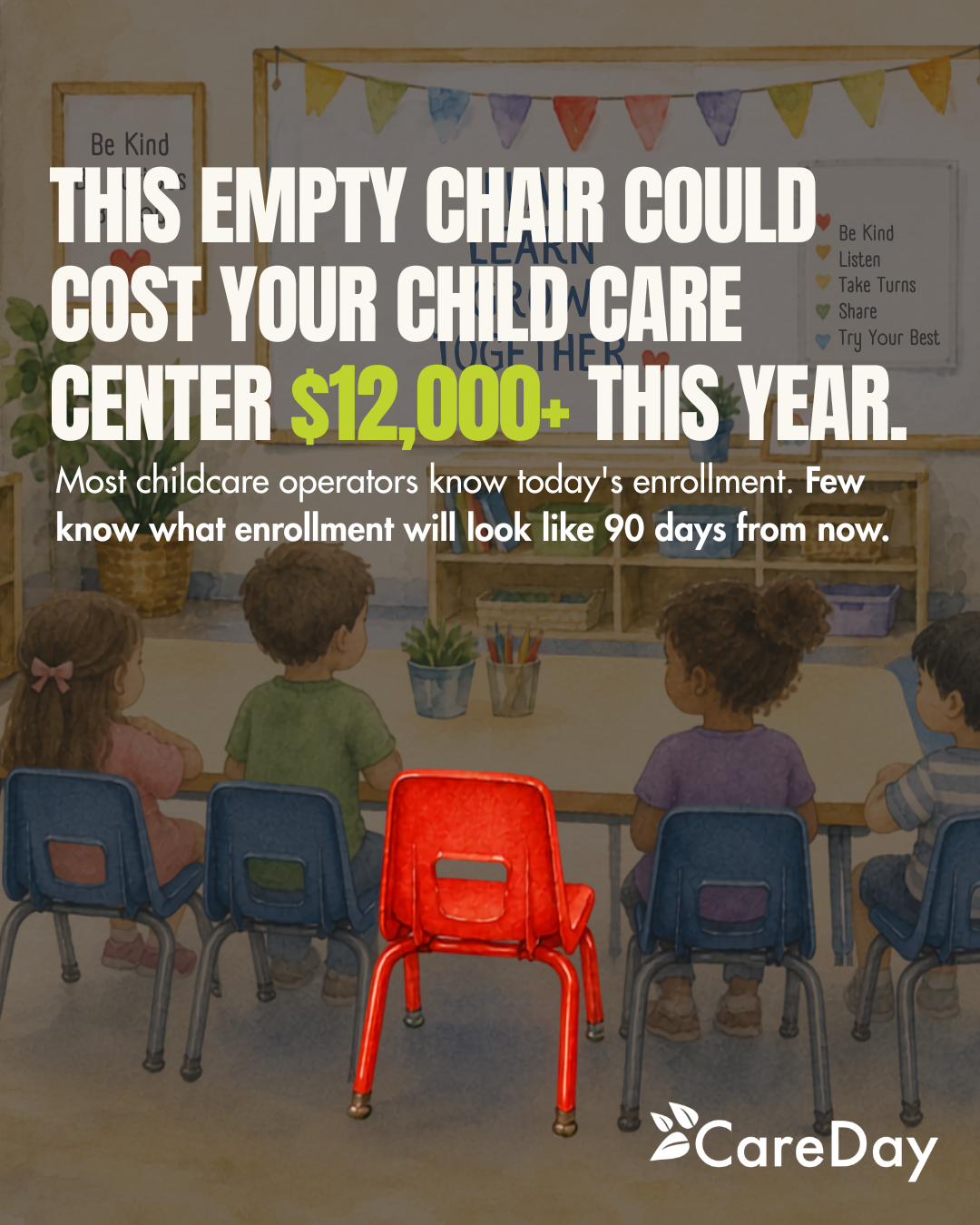
For most childcare directors, enrollment feels like something that just… happens. Families call, you tour them, they sign up — or they don't. But what if the gap between where your enrollment sits today and where it could be is costing you real money every single month?
It's easy to think of an empty spot as just a temporary inconvenience. A family moved, a sibling aged out, a waitlist just didn't convert fast enough. No big deal — you'll fill it eventually.
But "eventually" has a price tag.
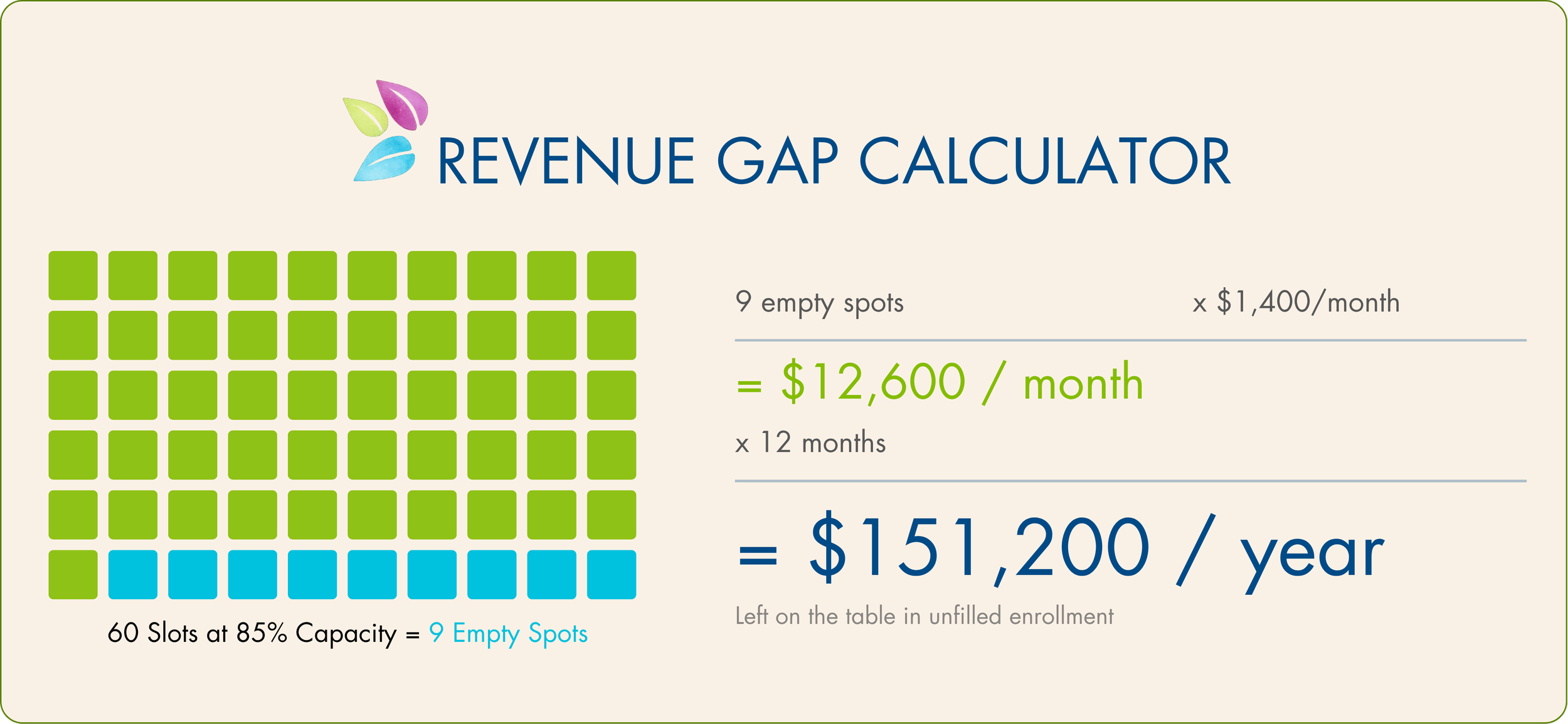
Take a center with 60 licensed slots running at 85% capacity. That's 9 open spots. At an average tuition of $1,400/month, those 9 spots represent $12,600 in monthly revenue you're not collecting. Over a year, that's $151,200 left on the table — not because families aren't out there, but because there was no system in place to see the gap coming and act on it early enough.
That's the hidden cost of not forecasting enrollment.'
See how CareDay gives you enrollment visibility before gaps happen. Book a Demo →
The Problem Isn't Empty Spots. It's Being Surprised by Them.
Here's what we hear from directors all the time: "We knew our numbers were down, but we didn't realize how bad it had gotten until we did payroll."
That moment — when financial reality surfaces through a spreadsheet or a paycheck run — is the moment forecasting is supposed to prevent. Because by then, you're already reacting. You're cutting hours, pausing hires, or scrambling to fill spots with discounted rates just to get heads in seats.
Enrollment decisions that feel last-minute usually aren't. They're the result of signals that were there weeks or months earlier — aging-out children, expiring contracts, families who stopped engaging — but without visibility into those patterns, the warning doesn't land until it's a problem.
What Forecasting Actually Changes
Enrollment forecasting isn't about predicting the future with perfect accuracy. It's about giving yourself enough runway to act.
When you can see that three infants are aging out of your youngest room in the next 60 days, you can:
Start marketing to that age group now, before the spots go empty
Prioritize your waitlist by age range, so the right families hear from you at the right time
Set rate expectations proactively, rather than discounting under pressure
Plan staffing with enough notice to avoid scrambling
None of those things are complicated. But they all require knowing what's coming. And most centers are operating without that view.
The Revenue Visibility You're Missing
The operators who grow — consistently, year over year — tend to share one habit: they treat enrollment like a financial metric, not just an operational one.
They know their utilization rate. They know which rooms are closest to capacity. They know which age groups are at risk. And they review that data regularly, not quarterly.
At CareDay, we work with centers across the country who've shifted from reactive to proactive on enrollment. One of our customers, Balanced Family Academy, grew from a single location doing roughly $117K/month to over $824K/month across four locations — and a big part of that is having real-time visibility into what their enrollment pipeline looks like, not just what it looks like today.
That's not a fluke. That's what happens when forecasting is baked into how you run the business.
A Simple Starting Point
If you're not currently forecasting enrollment, you don't need a complicated system to start. Here's what to look at every week:
How many children age out of each room in the next 30, 60, and 90 days?
What's your current waitlist by age group?
What's your current utilization by room?
How many inquiries did you get last week — and how many converted?
Those four questions, answered consistently, will surface the gaps before they become expensive ones.
The right software makes this automatic. The right mindset makes it a habit.
CareDay makes this automatic. See it in action →
The Bottom Line
Empty spots don't just mean fewer kids in your building. They mean lower revenue, tighter margins, harder conversations with your team, and more stress for you.
Forecasting doesn't eliminate turnover — families will always come and go. But it gives you the window you need to respond before a gap becomes a problem.
If you're curious what this looks like inside a platform built for childcare operators, we'd love to show you.
CareDay is a childcare management platform built for center operators — with tools for enrollment management, schedule-based billing, and revenue visibility across locations.